Pure Sudoku

Start here

Sudoku for beginners starts with three simple checks.

Each row, column, and 3×3 box must contain 1 through 9 exactly once. You never need arithmetic—only careful scanning and elimination.
Grid
9 rows × 9 columns
Goal
Digits 1 through 9
Best first move
Scan for singles
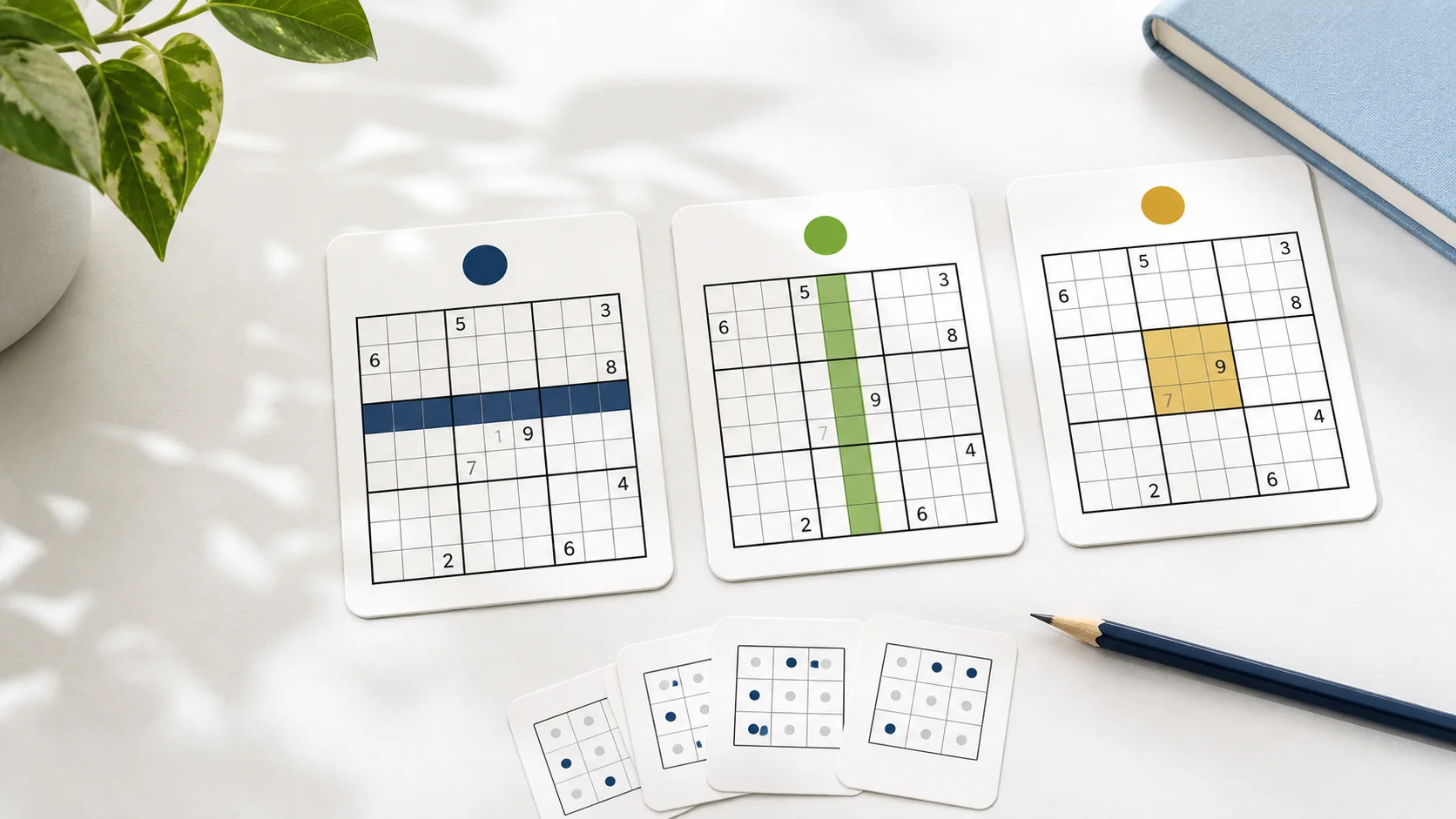
Sudoku teaching cards highlighting a row, column, and 3 by 3 box
Clear logic, focused practice, no guessing.

The three Sudoku rules

A number can appear only once in each row, each column, and each 3×3 box.

  • Check the row before entering a digit.
  • Check the column for the same digit.
  • Check the 3×3 box; if all three checks pass, the digit is a valid candidate.

How to solve your first puzzle

Start with the fullest rows and boxes because they have fewer missing numbers.

  • List the missing digits in one unit.
  • Test each empty cell against its row, column, and box.
  • Place a digit only when one location or one candidate remains, then scan again.

Beginner mistakes to avoid

Good habits keep a simple puzzle from becoming confusing.

  • Do not guess when two candidates are still possible.
  • Update pencil marks after every placement.
  • If stuck, move to another row or box instead of forcing a move.

FAQ

Quick answers before you play.

Is Sudoku math?

No. Sudoku uses the symbols 1 through 9, but solving depends on logic and pattern checking rather than arithmetic.

What difficulty should a beginner choose?

Start with Easy so the board offers frequent singles and clear scan opportunities.

Should beginners use notes?

Yes. Candidate notes are helpful when a cell has more than one possible value, but keep them updated after each placement.

Ready to solve?

Start an Easy puzzle

Open a clean Pure Sudoku board in your browser and put the guide into practice.