Must every cell in a naked triple have three candidates?
No. Two-candidate cells can participate as long as the three cells collectively contain exactly three digits.
Pure Sudoku
Intermediate technique
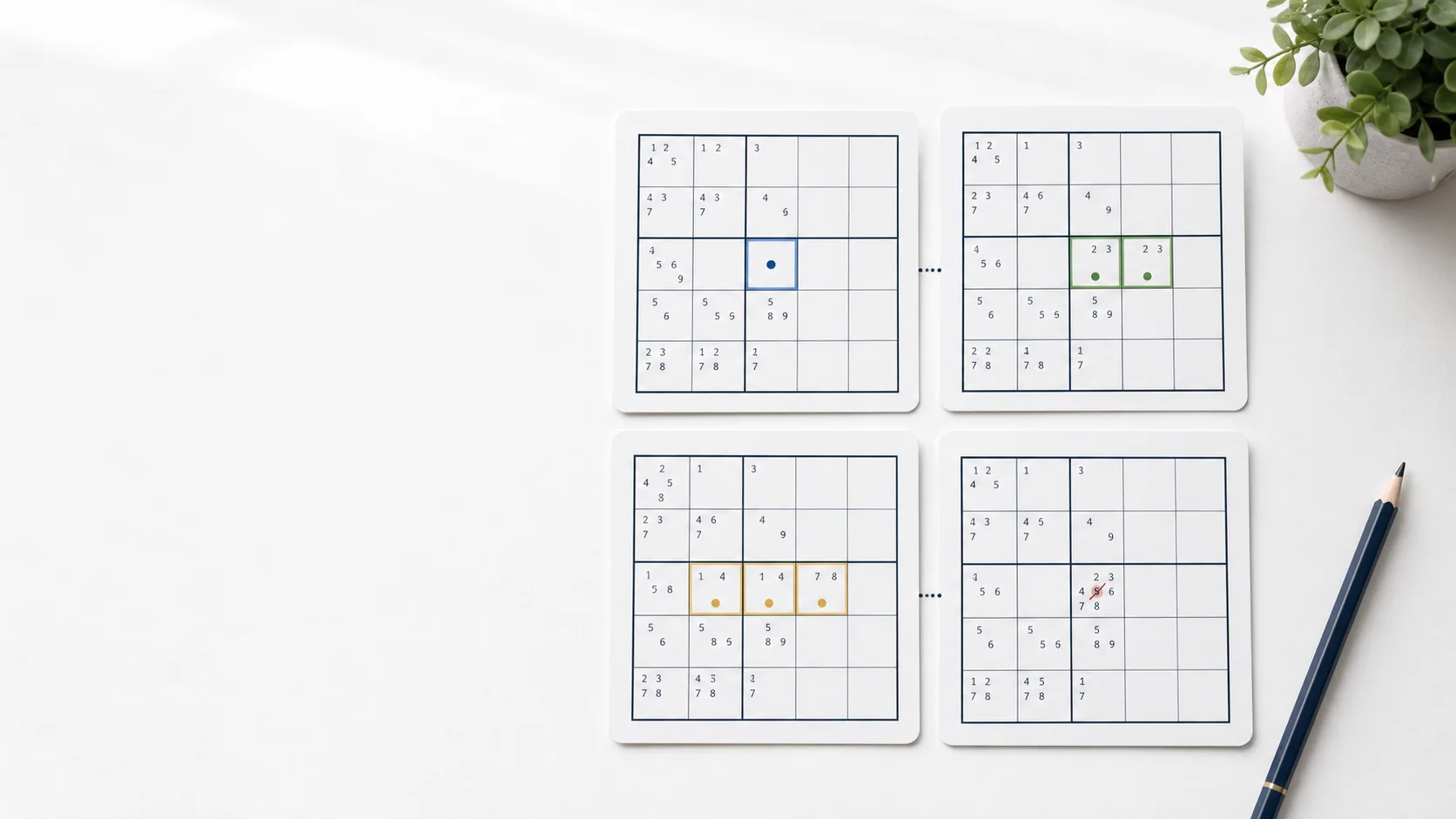
Three cells in one unit that collectively contain only three candidates reserve those digits, allowing you to remove them from every other cell in the unit.
Focused example
The highlighted cells show the exact scope of the pattern. Read the candidates before making an elimination.
How it works
Know the difference
A naked triple does not require all three cells to show all three digits. Sets such as {1,4}, {1,7}, and {4,7} still form the triple {1,4,7}.
After the move, re-scan the affected unit for singles before searching for another advanced pattern.
Continue playing
FAQ
No. Two-candidate cells can participate as long as the three cells collectively contain exactly three digits.
It removes the triple’s digits from all other cells in the same unit.
No. The three cells must share one row, column, or box for the elimination to be valid.
Practice loop
Pause when the board slows down, check the candidate conditions, make one justified move, and scan again.